Digital vs. Screen Printing for Small-Batch Fabric: A Practical Comparison
A first run is a peculiar kind of gamble. You need enough fabric to sell, photograph and test with real customers, but not so much that a design which flops leaves you with a cupboard full of unsellable cloth. The printing method you choose shapes that risk more than almost anything else — not only the unit cost, but the minimum you can order, the colours available to you and how the finished fabric feels in the hand.
Digital suits short runs, complex imagery and sampling. Screen printing suits repeats, bold flat colour and better value as volume climbs. Neither is automatically better; the right answer depends on your cloth, your artwork and how much you can spend before you have sold anything.
What each process actually does to your fabric
Digital textile printing works like a large-format inkjet printer. A printhead passes over the fabric and lays down ink: pigment, which is a binder that sits on the surface; reactive, which bonds with cellulose fibres such as cotton, linen and viscose; acid, for silk, wool and nylon; or disperse, usually applied to polyester by sublimation. There are no screens to make, so you can send a file and print a few metres.
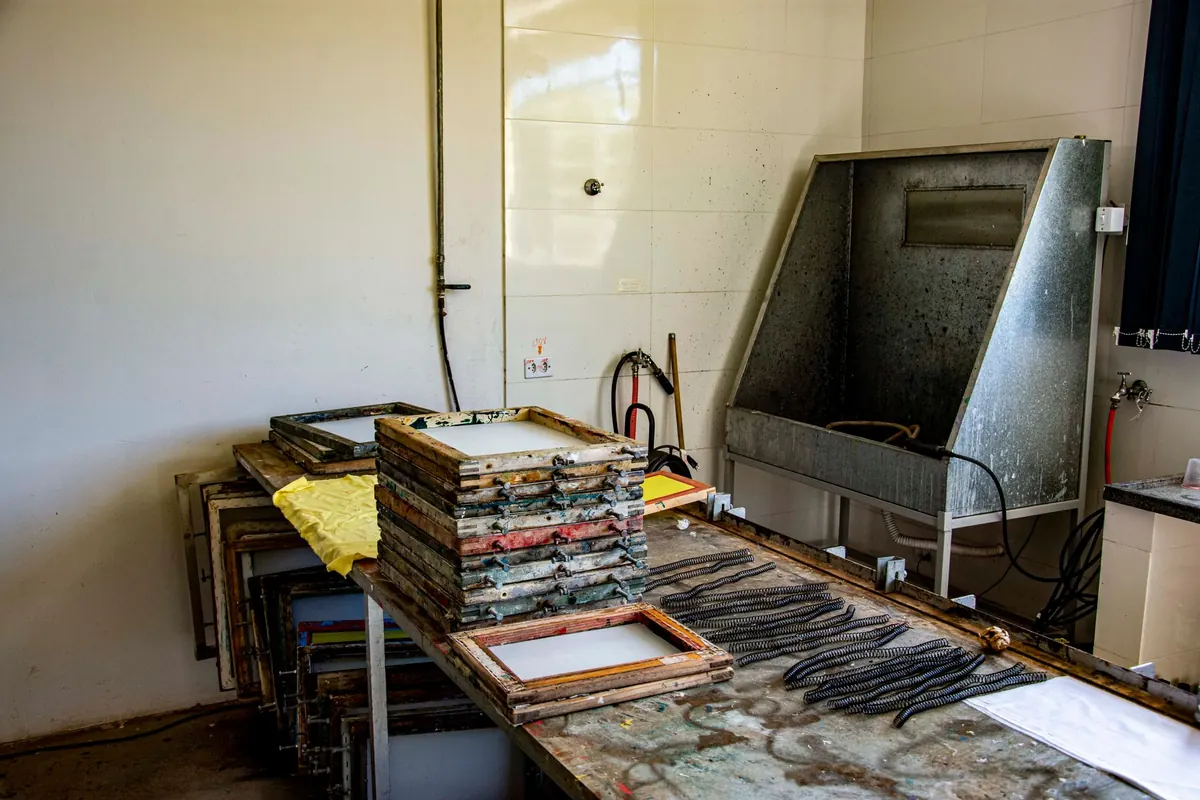
Screen printing pushes ink through a mesh stretched over a frame. Each colour needs its own screen, its own position and its own pass. Flatbed screens print panels and shorter lengths; rotary screens print continuous metres for larger runs. The ink deposit is controllable through mesh count and squeegee pressure, which is why screen printing can produce opaque brights, metallics, puff and discharge effects that digital struggles to match.
Minimums: what printers will actually accept
Minimum order quantities are commercial rather than technical, so they vary enormously. A digital bureau might print anything upwards of a single metre. A screen printer has to burn a screen for every colour and set up the press, so runs below roughly twenty to thirty metres often end up poor value; many will quote, but you may pay as though you ordered more.
The trap is forgetting the cloth itself. If your base fabric only comes in fifty-metre rolls from the mill, printing ten metres does not save you much. Ask the printer whether they can supply and print, or whether you need to bring your own fabric, and check their minimum for your specific cloth.
Where the costs sit
Digital printing puts the money into ink and machine time. Setup is minimal, so ten metres and a hundred metres are priced on a gentler curve — the per-metre rate simply drops as volume grows.
Screen printing is the reverse. Screens, film, colour matching, proofing and press setup are fixed costs that do not care how many metres you print. Once those are paid, the marginal cost per metre is low. That is why a screen quote at fifty metres can look expensive and the same quote at five hundred metres can look remarkably cheap.
Questions worth asking on any quote
- Is the fabric included, and at what width?
- Are screens, film and a strike-off charged separately?
- Is finishing included — washing, steaming, heat-setting?
- What happens on a reorder? Are the screens kept, and for how long?
- What is the lead time, and what happens if the print is wrong?
Colour limits and the flatness problem
Digital builds colour by mixing process inks, much as a desktop printer does. The gamut is wide but not infinite: vivid oranges, deep saturated blues and neon shades often fall short, and metallics are effectively off the table. Matching is approximate, and small variations between runs and between rolls are normal. Some printers run extended ink sets with extra channels to widen the range, so ask what they use.
Screen printing works with mixed spot inks, which makes matching to a reference far more reliable and consistent across repeat orders. The catch is that each colour needs a screen. One to eight colours is typical; beyond that, costs and registration risk climb quickly. Gradients and photographic images must be broken into halftone dots, and every screened colour is another screen, another pass and another chance for something to shift.
Finish quality and hand feel
This is where many designers get a surprise. Pigment printing sits a binder film on top of the cloth. On light coverage you barely notice it; print a dense dark field across a whole metre and the fabric can feel a shade stiffer and slightly rubbery. On stretch fabrics, a binder not formulated for stretch can crack over time. Reactive and acid digital inks penetrate the fibre, so they feel much closer to dyed cloth.
Screen printing can go either way. Discharge printing on cotton leaves virtually no hand at all, because it removes dye rather than adding ink. A heavy plastisol-style deposit, by contrast, sits proudly on the surface and gives strong opacity over dark grounds — something digital often cannot match.
Whatever route you take, wash the sample. Three domestic washes at the temperature your customer will use tells you more about fading, crocking and bleed than any proof on paper.
A practical way to decide
- How many metres will you realistically sell in the first six months? Use your cautious figure, not your hopeful one.
- Is your design built from flat colour blocks, or is it photographic and gradient-heavy?
- What is the base cloth? Natural fibres open up reactive and pigment digital; polyester usually pushes you towards sublimation.
- Do you need a soft handle, or strong opacity over a dark ground?
- Will you reorder the same design? Kept screens amortise their setup cost.
- How much cash can you commit before a single sale?
Plenty of small studios hedge. They print a digital strike-off, or a few metres in one colourway, to photograph and test with customers, then move to screen printing once a design proves itself. Others stay digital permanently because their artwork changes too often to justify screens.
Before you commit to a first run
Print a strike-off on the actual base cloth rather than approving a paper proof. Colours land differently on fabric, and the weave changes how fine detail reads. Check the printable width and the maximum repeat size for the method — digital presses have a width ceiling, and rotary screens are tied to a fixed circumference.
Get quotes at two or three realistic volumes so you can see where the crossover falls. Ask what finishing is included, because washing and heat-setting are not optional extras on most printed cloth. Build slack into the lead time, particularly around seasonal peaks.
If the first run is a serious spend, talk through cash flow and stock with your accountant before you commit. Then start smaller than feels comfortable. A short first run that sells out teaches you far more than a long one that sits in boxes.
Photo: Rodolfo Gaion / Pexels
You Might Also Like
A practical guide to re-engineering one repeat so it works at stationery and furnishing scale. Keep the rhythm, redraw the detail.
How floral, geometric and zoomorphic motifs differ, and why committing to one family makes a multi-print collection read as deliberate rather than accidental.